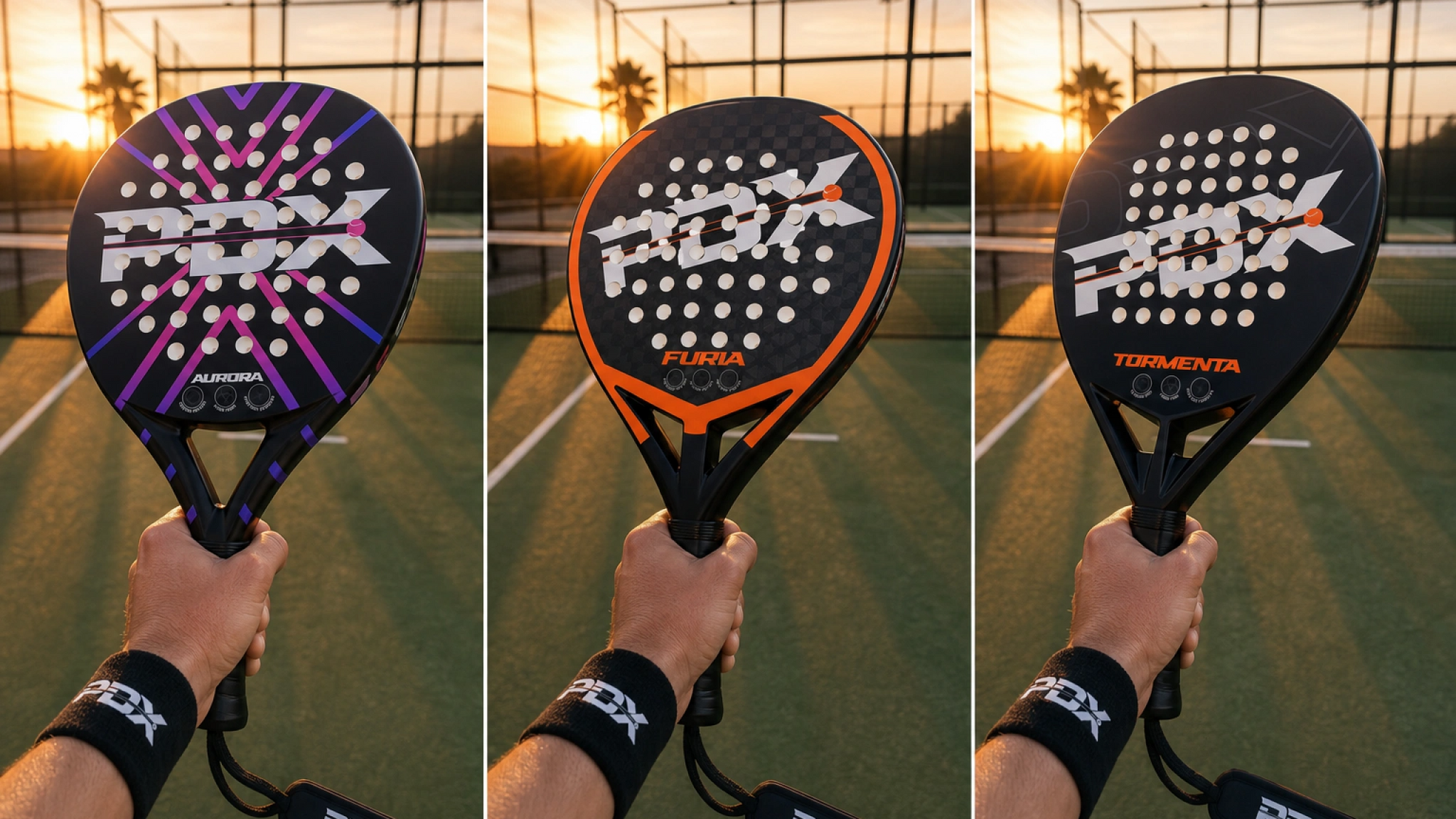

Fibreglass padel rackets are softer, lighter and more forgiving, giving beginners more comfort and control at a lower price. Carbon fibre rackets are stiffer, more durable and more powerful, suiting intermediate and advanced players. Most beginner rackets use a fibreglass face on a carbon-fibreglass frame, while full carbon rackets are built for experienced players.
Key Takeaways
- Fibreglass faces are softer and more forgiving, making them the best padel racket material for beginners.
- Carbon fibre rackets are stiffer, more durable and more powerful, suiting intermediate and advanced players.
- A 3K carbon weave feels slightly softer with more power; a 12K weave is stiffer with more control.
- Most beginner rackets pair a fibreglass face with a carbon-fibreglass frame for comfort and durability.
- The PDX Rayo and Aurora use a soft fibreglass face at £69.95, while the full carbon PDX Tormenta costs £99.95.
What is the difference between carbon and fibreglass padel rackets?
Carbon and fibreglass are the two face materials used on modern padel rackets, and they produce very different playing feels. Fibreglass is a soft, flexible material that absorbs impact and gives a comfortable, forgiving touch. Carbon fibre is a stiff, responsive material that returns energy quickly and produces more power.
The difference matters because the face material is what the ball actually strikes on every shot. A fibreglass face cushions the ball, giving you more dwell time and control, while a carbon face springs the ball away, adding speed but demanding better technique. Beginners benefit from the forgiveness of fibreglass, while advanced players use carbon to generate explosive power. Most PDX rackets pair the face material with a frame that may be full carbon or a carbon-fibreglass blend, as we explore in our full padel racket guide. The table below sets out the key differences side by side.
| Property | Fibreglass | Carbon fibre |
|---|---|---|
| Feel | Soft, flexible | Stiff, responsive |
| Power | Lower | Higher |
| Control & comfort | Higher, forgiving | Precise but demanding |
| Durability | Wears faster | More durable |
| Price | Cheaper | More expensive |
| Best for | Beginners, casual | Intermediate, advanced |
Fibreglass padel rackets: pros and cons
A fibreglass padel racket uses a soft, flexible face material that flexes on impact and cushions the ball. The main advantage is comfort: the softer face absorbs vibration and forgives off-centre hits, so beginners can develop technique without the racket punishing every mistake.
Fibreglass faces also give more dwell time, meaning the ball sits on the face a fraction longer, which helps you direct shots with control rather than raw power. The trade-off is that fibreglass is less durable than carbon and wears faster over months of regular play, and it produces less power because it absorbs energy rather than returning it. Fibreglass rackets are also cheaper to manufacture, which keeps the price down — the PDX Rayo beginner racket and the PDX Aurora both use a soft fibreglass face at £69.95. In our experience PDX players find fibreglass faces noticeably gentler on the arm during long sessions, especially in cold UK weather where stiffer faces feel harsh.
Carbon fibre padel rackets: pros and cons
A carbon fibre padel racket uses a stiff, responsive face material that returns energy to the ball on impact. The main advantage is power: carbon springs the ball away quickly, so well-struck shots travel faster with less effort. Carbon is also more durable than fibreglass, resisting cracks and surface wear over a longer playing life.
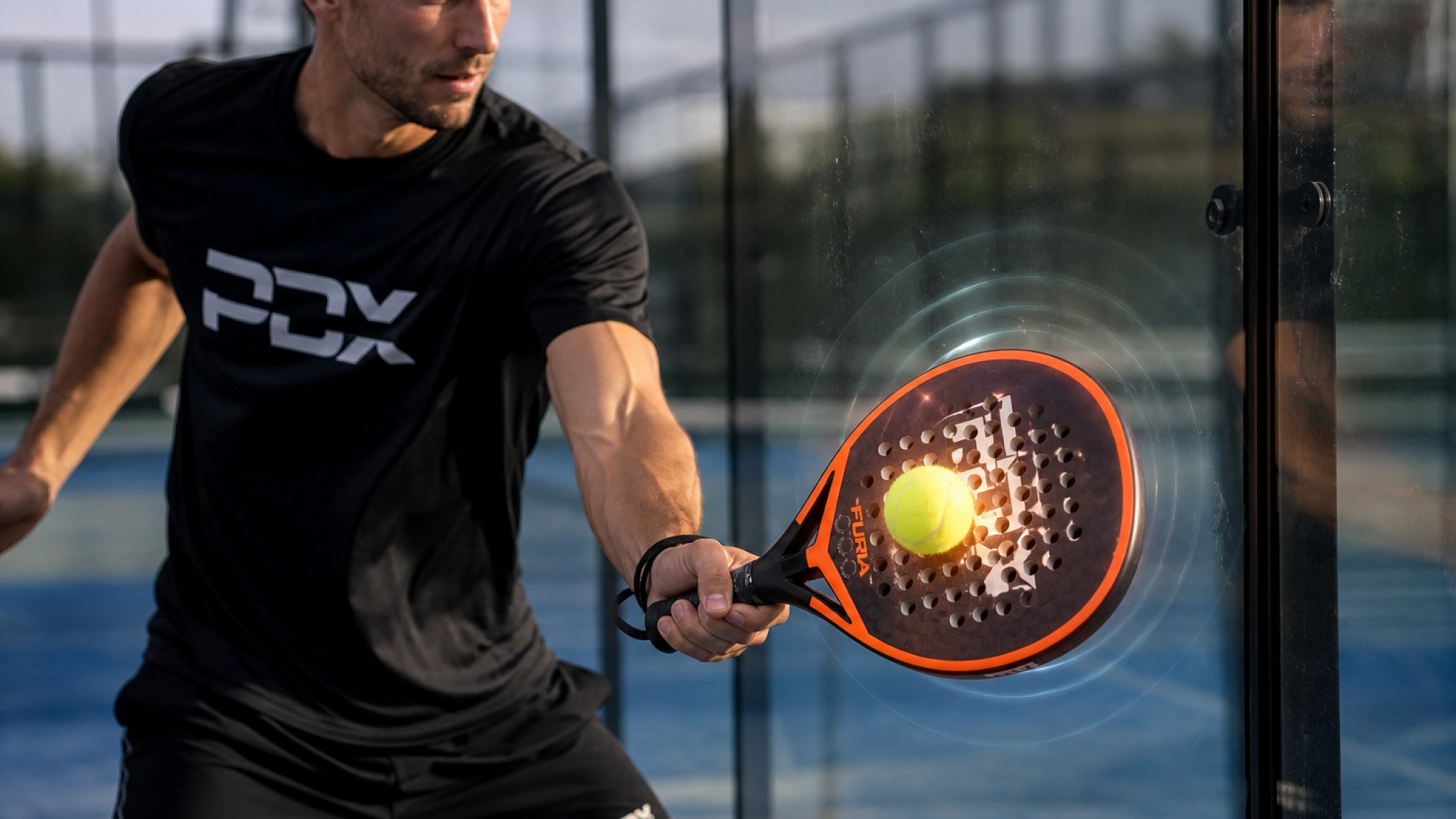
The trade-off is that carbon is less forgiving — off-centre hits vibrate more and the stiff feel demands good technique, which is why carbon suits intermediate and advanced players rather than beginners. Carbon rackets cost more because the material and weaving process are more expensive. The PDX Tormenta uses a 3K carbon face at £99.95 for intermediate players, while the PDX Furia uses a 12K carbon face at £139.95 for advanced players. For a wider look at how price tracks with material and technology, see our guide on cheap vs expensive padel rackets.
What do 3K, 12K and 18K carbon mean?
The K number on a carbon padel racket describes the weave density of the carbon fibre cloth — how many thousands of filaments are bundled into each tow. A 3K weave has 3,000 filaments per tow, 12K has 12,000 and 18K has 18,000. Lower K weaves like 3K are slightly softer and more powerful because the cloth is more flexible, while higher K weaves like 12K and 18K are stiffer and give more control and precision because the cloth is denser.
The weave changes the feel more than the raw power, so choosing between them is about your playing style and level. PDX uses a 3K carbon face on the Tormenta for improving players who want power, and a 12K carbon face on the Furia for intermediate-advanced players who want control. PDX does not make an 18K model, but we include it here for completeness so you understand the full range when comparing brands.
| Carbon weave | Feel | Best for |
|---|---|---|
| 3K | Powerful, slightly softer | Improving / intermediate |
| 12K | Stiffer, more control | Intermediate–advanced |
| 18K | Very stiff, maximum precision | Advanced |
Frame vs face: why the combination matters
A padel racket has two distinct parts: the face, which is the flat hitting surface, and the frame, which is the structural hoop around the edge. The face material controls feel, power and control on every shot, while the frame controls stiffness, durability and weight distribution.
Most beginner rackets use a fibreglass face for comfort paired with a carbon-fibreglass frame that adds durability without making the whole racket too stiff — the PDX Rayo, Aurora and Cub all use a 30% carbon / 70% fibreglass frame. Full carbon rackets use carbon for both face and frame, giving maximum stiffness and power for experienced players who can handle the firmer feel. The combination matters because a full carbon frame with a fibreglass face would feel inconsistent, and a fibreglass frame with a carbon face would lack the structural stiffness to support the stiff face. For more on how the internal core works alongside these materials, see our guide to the padel racket EVA foam core.
Which material is best for beginners?
Fibreglass is the best padel racket material for beginners because it is softer, more forgiving and cheaper than carbon. A fibreglass face cushions the ball on impact, giving beginners more control and comfort while they learn the basic strokes.
The softer feel also reduces vibration, which is gentler on the arm and helps prevent the early fatigue that puts new players off the sport. A full carbon racket is a poor choice for most beginners because the stiff face punishes off-centre hits and demands consistent technique that new players have not yet developed. The best beginner setup is a fibreglass face on a carbon-fibreglass frame, which gives comfort where you hit the ball and durability where the racket takes impacts. Do beginners need carbon? No — a fibreglass face with a blended frame is the proven formula, and it keeps the price affordable at £69.95 for the PDX Rayo and Aurora. Shape also plays a role in forgiveness, so read our guide to padel racket shapes explained alongside this material choice.
Which PDX racket material is right for me?
The right PDX racket depends on your level and how much power versus comfort you want. Beginners should choose a fibreglass face on a 30/70 carbon-fibreglass frame for forgiveness and value. Intermediate players ready for more power should step up to a full carbon body with a 3K carbon face. Advanced players who want control and precision should choose a full carbon frame with a 12K carbon face. The table below matches each PDX racket to the right player level.
| Level | Material | PDX racket | Price |
|---|---|---|---|
| Beginner | Fibreglass face, 30/70 frame | PDX Rayo / PDX Aurora | £69.95 |
| Kids 6–12 | Fibreglass face, 30/70 frame | PDX Cub | £59.95 |
| Intermediate | Full carbon, 3K face | PDX Tormenta | £99.95 |
| Intermediate–advanced | Full carbon, 12K face | PDX Furia | £139.95 |
Browse the full range of beginner padel rackets or intermediate padel rackets to compare every model side by side.
FAQ
Which is better, carbon fibre or fibreglass padel rackets?
Neither is universally better. Fibreglass is softer and more forgiving for beginners; carbon is stiffer, more powerful and more durable for intermediate and advanced players.
Do beginners need a carbon padel racket?
No. Beginners usually play better with a fibreglass face for comfort and control. A carbon-fibreglass frame adds durability without making the racket too stiff.
What do 3K, 12K and 18K carbon mean?
The K number describes the carbon weave. Lower K such as 3K feels slightly softer with more power; higher K such as 12K or 18K is stiffer with more control and precision.
Are carbon padel rackets more durable?
Generally yes. Carbon frames resist wear and cracking better than all-fibreglass frames, especially in cold UK playing conditions.
What material gives the most control?
A fibreglass face gives a soft, forgiving touch for control at beginner level, while high-K carbon gives controlled precision for advanced players.
Ready to choose your padel racket material?
Start with a fibreglass face if you are new to the sport, then move to full carbon as your technique and power develop. Browse the beginner padel rackets collection to find your first racket, or explore the intermediate padel rackets collection when you are ready for carbon.